








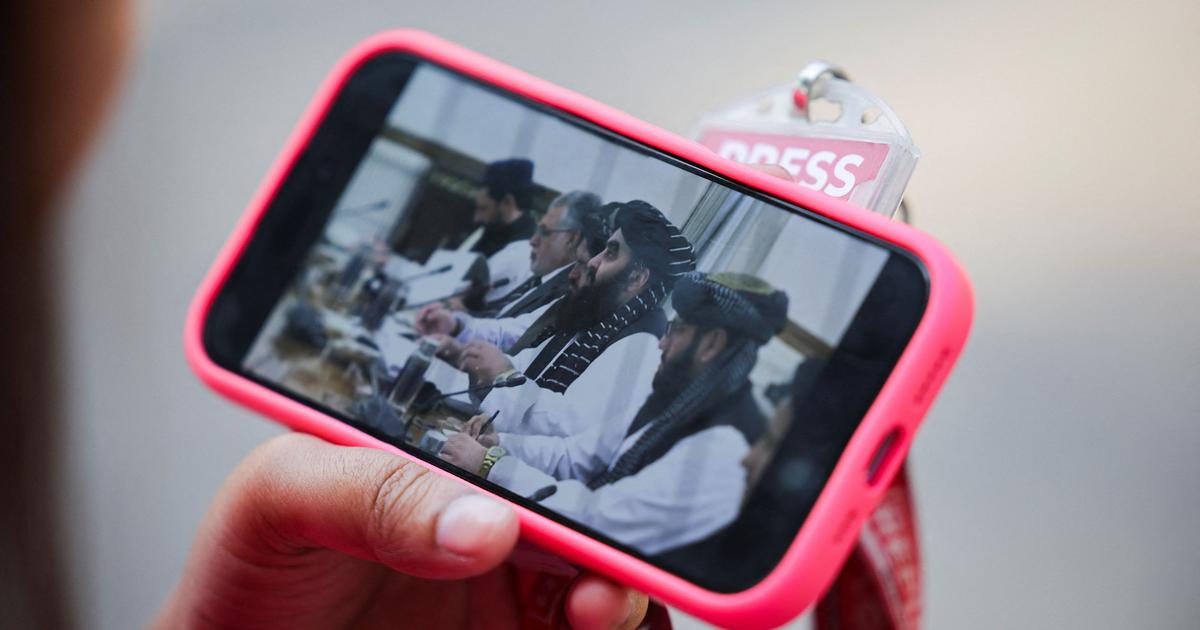
Amid concerns that Indian news channels were sensationalising the conflict in West Asia, the Union government on March 6 directed the Broadcast Audience Research Council to suspend the publication of Television Rating Points for at least a month.
The council measures the viewership of channels in a business in which the metrics are important to attract advertisers.
Curiously, the channels have not pushed back against the order, the Business Standard noted on March 29. The reason for this silence is that news channels, like overall traditional TV, are on the decline, industry professionals told the newspaper.
With news constituting just 7% of all content consumed on TV and more viewers watching shows and clips online, TRPs are losing their importance.
Some of these online creators include YouTube news channels that are finding remarkable traction, with the platform becoming a go-to medium for the masses.
4PM News UP has 1.7 million subscribers and has been viewed more than 600 million times since 2021. Article 19 News has 4.5 million subscribers and 1.3 billion views since 2020. National Dastak has had 10.8 million subscribers and 4.3 billion views in the past decade. They also post on other platforms such as Facebook.
They stand apart because of their content. They report stories that are relevant to those on the margins – something that the TV channels do not.
This contrast between the traditional media and new-age online creators assumes significance when one considers the government’s recent draft amendments to the 2021 Information Technology Rules.
The authorities have proposed to bring independent news content creators, who are not designated “publishers”, or user-generated news under the 2021 rules.
If the draft amendments are approved, “news and current affairs” creators will be covered by a mechanism used by the Ministry of Information and Broadcasting to block content. This could pose a threat to citizen journalism.
The role of the inter-departmental committee that ensures compliance is also being expanded, empowering it to scrutinise content even without receiving any complaints about programming.
The blocking mechanism is already being used by the government arbitrarily and extensively, often without explanation.
In March, several social media accounts that are viewed as being critical of the government and even news posts (including those of Scroll) were blocked in India.
In fact, the Facebook pages of 4PM News, National Dastak and another YouTube channel Molitics were among those blocked in the past three weeks.
Some of these takedowns were under a provision of the 2000 Information Technology Act that allows the authorities to remove the “safe harbour” protection of social media platforms that do not act on removal orders.
The main YouTube channel of 4PM News was blocked on March 12 citing national security concerns. It had also been blocked in May 2025, a move the channel had described as an attempt to “crush a strong voice of democracy in the name of national security”.
National Dastak’s YouTube channel was briefly blocked in April 2024 during the Lok Sabha elections.
Information and Broadcasting Minister Ashwini Vaishnaw claimed that the takedown orders were to curb deepfakes generated by Artificial Intelligence. But the Opposition claimed that the government was blocking these accounts because it is scared of questions that mainstream media does not ask.
The government’s actions are being viewed as an attempt to rein in the last vestiges of India’s independent news media, which now mainly survives online. The government wants to exert the same narrative control on online news creators that it has on TV channels.
Advocacy group Internet Freedom Foundation on March 30 said that the proposed amendments to the IT rules signalled a “decisive turn toward executive-led content control” and a “massive expansion of unconstitutional censorship”. The inter-departmental panel “now operates as a free-standing censorship committee”, it added.
Here is a summary of last week’s top stories.
A tense election. The Supreme Court directed the deployment of central forces to provide security to judicial officers helping complete the special intensive revision of electoral rolls in West Bengal. A bench issued the order after taking note of seven judicial officers allegedly being gheraoed for hours in Malda district a day earlier.
They were reportedly held hostage by a mob protesting against the alleged mass deletion of voters during the revision exercise. The officers were released after midnight following the intervention of the Calcutta High Court chief justice.
Chief Minister Mamata Banerjee alleged that the Bharatiya Janata Party had paid “some traitors to provoke” voters, and urged residents to remain calm. The ruling Trinamool Congress claimed that Union Home Minister Amit Shah was at fault for the incident.
The police arrested a man, Moffakkerul Islam, who allegedly organised the gherao.
Millions of Bengalis may lose their vote. Not over citizenship but due to clerical errors, writes Shoaib Daniyal.
Adani’s takeover challenged. Mining company Vedanta moved the Supreme Court seeking a stay on the proposed takeover of the now-insolvent Jaypee Group’s assets by billionaire Gautam Adani’s Adani Group. The Anil Agarwal-led company has argued that its offer for Jaiprakash Associates Limited was higher, and questioned the fairness and transparency of the bidding process.
The plea was filed days after the National Company Law Appellate Tribunal declined to grant an interim stay on the National Company Law Tribunal’s approval of the resolution plan submitted by Adani Enterprises. The Committee of Creditors had approved the Adani bid, which was subsequently cleared by the National Company Law Tribunal.
Vedanta chairperson Agrawal claimed that his company was declared the highest bidder during the insolvency proceedings and was informed in writing that it had won, before the outcome was later changed.
Another temple stampede. At least nine persons were killed and several others injured in a stampede at the Sheetla Mata temple in Bihar’s Nalanda district. Most of those who died are reported to be women.
Nalanda Superintendent of Police Bharat Soni said there was a massive crowd at the temple and that the police had no information that there would be such a rush. Residents complained that there were inadequate crowd control arrangements at the site.
Also on Scroll last week
- Battered by BJP rule, Assam’s Miya Muslims pin no hopes on the election
- PM Modi put himself at the centre of India’s foreign policy. Now the joke is on him
- A man on a cellphone tower in Punjab is at centre of gathering protest for anti-sacrilege law
- Hundreds of Tamil Nadu fishermen are stuck in Iran – many of them on their boats
- Bangladesh’s reform plan is trapped in a legal design of its own making
- Changes to trans rights act will worsen access to healthcare for vulnerable individuals
- Panipat’s battle for labour rights shows why workers across India are going on strike today
- Many takers for public policy studies, but that is unlikely to improve India’s governance problems
- ‘The Drama’ review: Relationship film has a crusty exterior and a tender heart
- Review: ‘Maa Ka Sum’ doesn’t add up
Follow the Scroll channel on WhatsApp for a curated selection of the news that matters throughout the day, and a round-up of major developments in India and around the world every evening. What you won’t get: spam.
And, if you haven’t already, sign up for our Daily Brief newsletter.
